
TPO Commercial vs RV
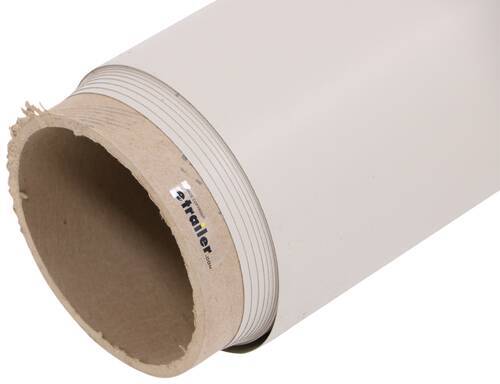
We have covered some EPDM RV roof basics; now, let us look at the second-most-common RV roof material used by major manufacturers. Alpha Systems and Dicor both make TPO roofs for RVs, but they differ from commercial TPO roofs. The needs of RVs are different from those of commercial buildings. To work correctly on an RV, a membrane is typically thinner and formulated for lamination to luan.
It’s important to understand that TPO roofing is a term used in both the RV industry and commercial construction, but the two systems share little beyond the name.
RV TPO
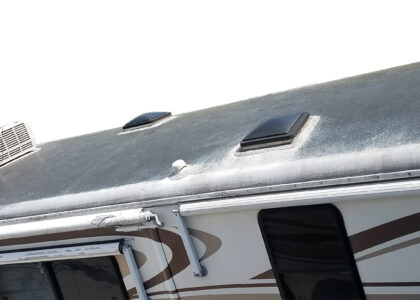
Both roof types are installed in the same way. The core of the roof is foam insulation between rafters, and Luan decking is adhered to the core. The thickness of this luan is 1/8”-3/16ths. An adhesive formulated for the roof material is applied to the decking. If the adhesive is not evenly applied, you will see bubbles and wrinkles. Correctly installed RV TPO roofs are run through a press, forcing out air bubbles and making sure the membrane is fully adhered, making it a true laminated roof.
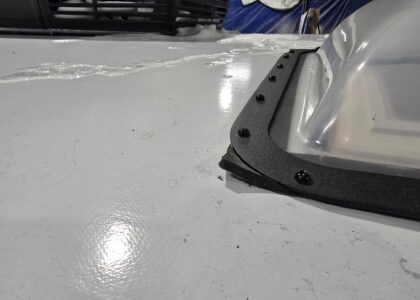
A mesh tape is applied over the seams where the luan sheets meet. This tape serves several purposes, the main one being that it spreads the stress from the plywood edges over a large area, reducing the risk of cracking or adhesion failure. Side note: This seam can appear as a wrinkle after the RV has been outside. It is perfectly normal and does not indicate a bad roof. A large sheet of TPO is rolled over the roof. On the sides and ends, aluminium termination rails are installed, typically with butyl tape under the strip.
The thickness of all brands is .035-.045 inches, providing the flexibility needed for RV roofs. This flexibility is important because RVs flex. Ever notice interior doors jam or fail to latch as the vehicle shifts from one campsite to another? If the roof material couldn’t flex, it would pull away from the edges, where it rests under termination rails. RV TPO, with 350% elongation, stretches and stays attached at mechanically fastened areas.
Commercial TPO
Commercial buildings use thicker membranes, welded seams, and large, long-lasting roof assemblies, while RV roofs use thinner, laminated membranes that flex with the vehicle’s structure. This highlights how commercial roofs prioritise durability and rigidity, but RV roofs focus on flexibility and weight savings.
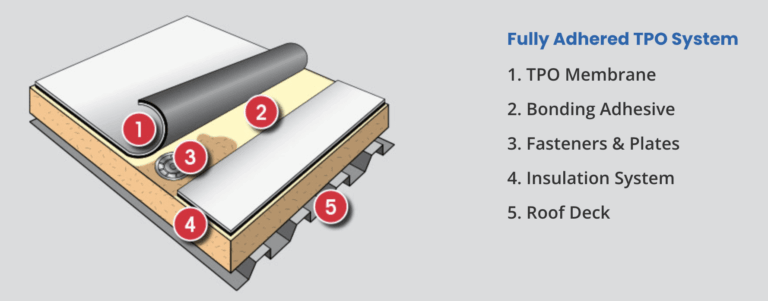
Commercial TPO roofing does not adhere directly to the roof deck. Instead, insulation boards are installed first, and the TPO membrane is bonded to them with adhesive. Seams and edges are mechanically fastened. Each new sheet overlaps the previous one, and the overlap is heat-welded to form a watertight seal. TPO membranes must be laid flat or bent with a rolled radius; sharp 90-degree angles put stress on the membrane, causing microcracking, fatigue, and eventual splitting at corners and edges. Understanding these details is crucial for proper installation and long-term performance.
Commercial TPO is .045-.080 inches thick and designed to last decades outdoors. Thicker material means less flexibility, usually 200%. Commercial buildings are solid and do not flex, except for minor expansion and contraction. Their roofs are stationary and resist weather more than constant structural movement. In contrast, RVs experience vibration, chassis flex, and wind uplift. This stresses commercial-grade roofing on RVs.
What to consider if using commercial TPO on RV Roof.
Several companies install commercial-grade TPO on RVs. Search online for providers like RV Roof Worx and RV Roof Install. If you consider them, be aware of the issues—commercial-grade materials were designed for stationary buildings.
Since the material they advertise is thicker and stiffer, it will experience more stress than a more flexible RV roof TPO. Commercial TPO contains a polyester reinforcement scrim. This scrim gives it strength but also limits its bending. Commercial TPO manuals recommend avoiding sharp bends, using cant strips, and curving the edge metal by at least 1/2 inch to prevent 90-degree folds.
RV Roof Install, using Carlisle Systems, is installing the roofing material in direct contradiction of the company’s manual. RV Roof Install is providing a stronger impact-resistant roof material than traditional RV TPO. The con is that the bends on the sides are prone to cracking at the edges, creating an area for water intrusion. RV Roof Worx doesn’t specify exactly which product they are installing, but they offer the same 20-30-year warranty and advertise heat-welded seams, traits of commercial-grade TPO.
In Conclusion
Most RV roof companies stick to RV TPO. This is most likely because commercial TPO manufacturers design their systems for buildings, not vehicles, so they won’t warranty RV installations. These systems are engineered for buildings and rely on specific installation methods, flashing details, and edge terminations designed for commercial roof assemblies, not RVs. Carlisle Syntec Gaf Everguard Although RV TPO and commercial TPO are both thermoplastic roofing membranes, they serve distinctly different purposes.
In recent years, RV Roof Install and RV Roof Worx have advertised commercial-style TPO membranes for RV roofs. This approach interests RV owners seeking long-term solutions. While these installations may have merits, they also raise questions about how materials for stationary buildings perform under vibration, movement, and varying structural conditions.
The purpose of this article is not to criticise those efforts, but to help RV owners better understand the key differences between RV and commercial TPO roofing systems. By examining differences in material manufacturing, installation methods, and intended environments, owners can make more informed decisions about the types of roofing systems offered.
As new RV roofing approaches appear, understanding technical differences becomes more important. Sometimes, adapting commercial techniques brings benefits. Still, matching material, installation, and structure remains key to long-term roof performance.