

We Dropped the Ball
Sometimes it takes a snarky Facebook post to realize you aren’t accomplishing what you started out to accomplish. We are a group of experts in our fields, who enjoy RVing and sitting around the campfire. As a matter of fact, that is where this idea was first conceived. We read all the same articles you do, and see the same social media posts you do. Advice given by people who know nothing about roofing, materials, RVs, or material compatibility. Like a rumor, this misinformation is spread quickly. Why does wrong information spread faster than correct? A little outside our scope of knowledge, but it seems to ring true. We are here to change how we talk about RV roofs, going back to our idea of straight talk.
What Now?
We wanted to share facts and decided to start there, then move into more detail, comparing companies and citing real-life examples. Education, we thought, would help fellow RV owners cut through the hype. Instead, we are boring the very people we want to reach. Instead of being someone we aren’t, we will be who we are: blue-collar workers with over 30 years of experience in construction, roofing, and RV maintenance.
We are starting over. Really talking about RV roofs. Not giving the same old, dry technical data.
We already covered some facts about rubber roofs. We know it was boring. We were bored reading it and proofreading the blog. One of the main points we wanted to make was that if your roof is black, you need a new roof. You choose to roll something on. Here is what works and doesn’t work. Facts and knowledge to combat the RV Roofing Solutions tech who swears you won’t have an issue. We should have just spelled that out.
Why did the RV industry change the roof?
If we are talking about RV roofs, we have to start with the most obvious question. Why in the world did the RV industry start using rubber roofs? We all know grandpa had a camper, or an uncle, and they never spent time messing with constant maintenance on their camper. In a nutshell, in the late 1970s, commercial roofing began using EPDM. Surprise, surprise, you guessed it, it was cheaper. Until then, aluminum and fiberglass were the standard materials for RV roofs.
Shocker. Cheaper. Faster.
Cheaper to manufacture, cheaper to install, and faster for a production line than aluminum. Have you ever seen an old Holiday Rambler? Aluminum with a seam down the middle. EPDM allowed RV builders to have a solid piece with no seams. On an assembly line, they could roll out a single sheet, cut out the holes, and move it on down the line.
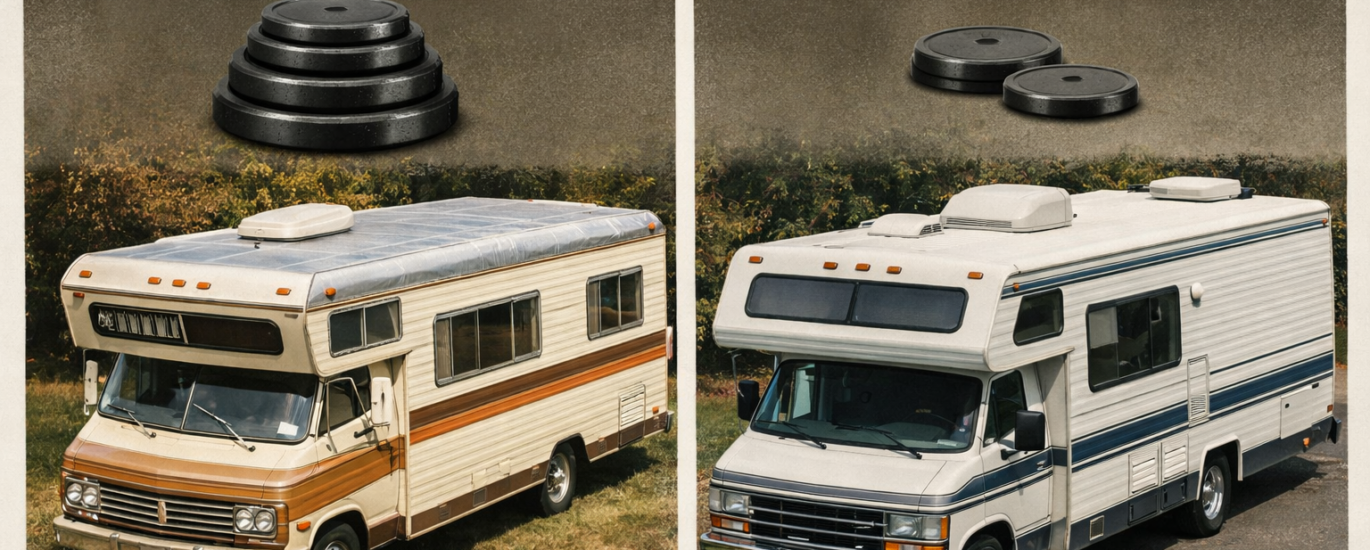
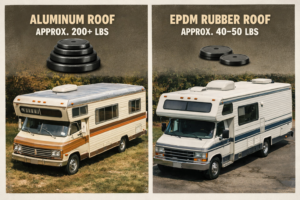
In the late 70s, there was a fuel crisis. The impact on the RV industry was staggering, and change was needed. Fuel efficiency was on everyone’s mind. Consumers wanted to camp but needed smaller, lighter RVs. Engineers started asking, how can we cut weight without hurting the function. One thing that popped up was this new, lighter roofing material being used in commercial roofing. The roof is the one thing no one looks at or even thinks about. Aluminum roofs weighed around a pound per square foot. EPDM weighed around .35 of a pound. The RV industry thought they had found the magic solution: they could increase their profit margins, and customers would spend less on gas. Win, win. Too bad it wasn’t. The RV industry was winning, but the customer wasn’t.
Demand up. Quality down.
EPDM roofs were great at the start. In the 70s and 80s, RVs were built more slowly. Slower builds meant more controlled installation. Taking time to evenly spread glue, wait for it to get tacky. Real proper installation. If you ever find an older motorhome with no roof leaks, take a look. Not a single wrinkle, bubble, or imperfection to be seen. Pride in the brand was evident, seen in every aspect of an RV. We would love to see the details that you found on Safari motorhomes. Beautiful airbrushed pictures, with hidden wildlife, return to the industry.
Then came the late 90s and 2000s. Demand increased, production got faster. Money overruled brand pride; the assembly line was king. Faster was the only focus, and the quality of RVs began to decline rapidly. Common opinion is that it peaked during COVID. The truth? Quality is worse now. Service centers are filled with warranty roof work. Blowing off, not fully under transition strips, missing caulk. All direct results of hurrying the build process.
Let's talk wrinkles again. Plainly.
This doesn’t mean that you have to replace your roof if it has these blemishes. Watching the wrinkles and bubbles is important; you need to know whether you have a small issue or a real one. Most are cosmetic. What isn’t cosmetic? The areas are getting bigger and bigger, a sign of complete adhesion failure. Wrinkles at your front transition strip that seem to change and grow after every trip. You are probably blowing up going down the road. Another sign, cuts under the front of your AC. Going down the road, it blows up and stretches against the AC, finally cutting the membrane. This is the hardest failure to spot. At the beginning, the membrane lies flat when you aren’t moving. Wrinkles form when it’s stretched too much.
Coming up next? A real dive into the roof. Imperfection or problem.
We will dive in and start showing real-world cases, changing the way we talk about RV roofs. No more dry boring blogs. Share knowledge to help you identify worrisome issues on your EPDM membrane. And all other roof types. Give you the tools to combat the industry’s default answer when you know you have an issue that is not cosmetic. We hope you follow our blog and our FB page, and ask us questions. What do you want more information about? Did you not quite believe the tech who was at your RV yesterday? Starting today, we will give you the information straight up, not buried in pretty fluff. Being who we are and doing what we started out to do. Real talk, based on fact. Next up? Signs to look for when it comes to bubbles and wrinkles. Tactics you can use with the manufacturer to resolve failures.